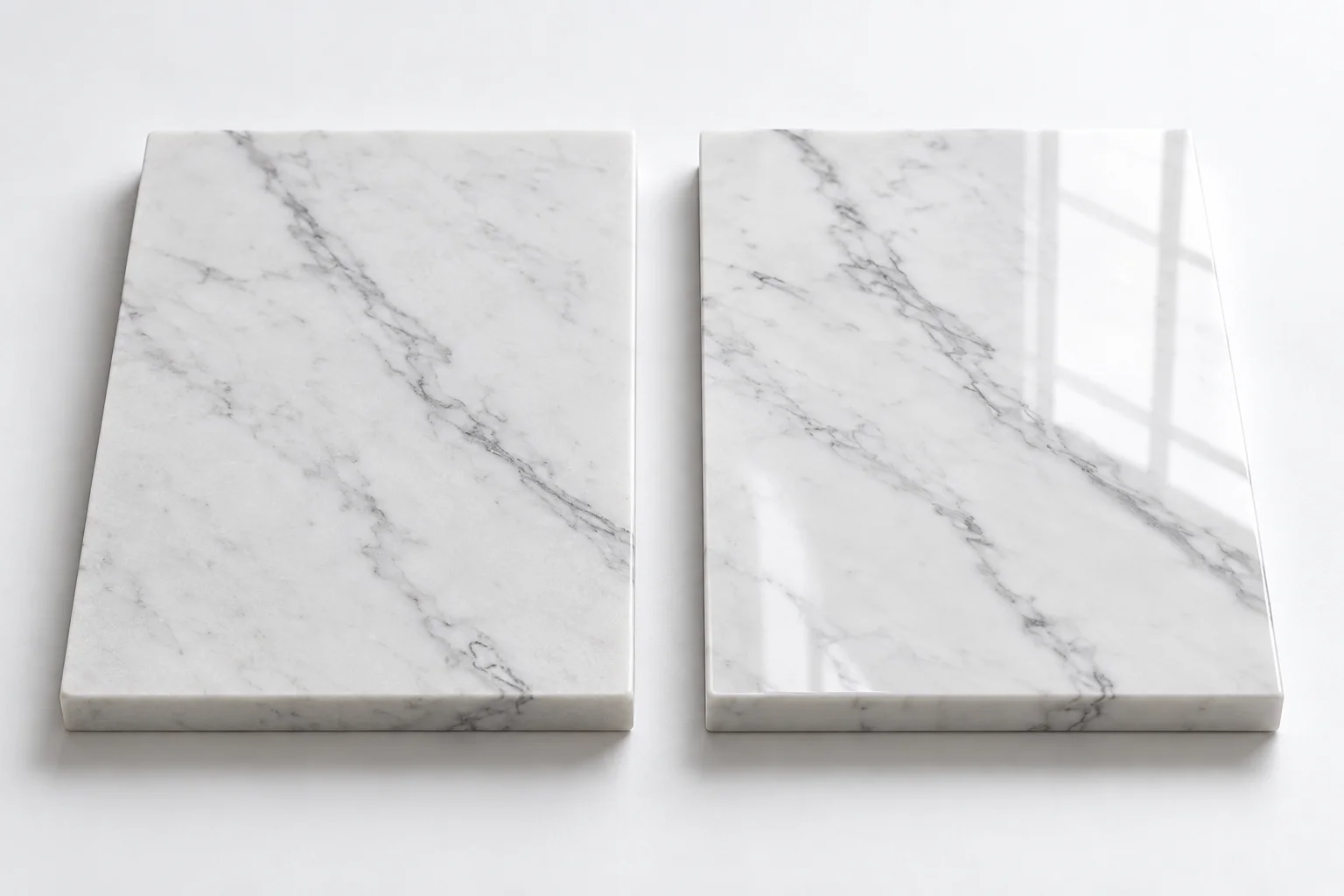
Quick summary
Polished marble reflects light; honed marble has a low-sheen surface. Both remain marble and can etch. Choose with a sample of the same stone under project lighting, then confirm care and application requirements.
Key takeaways
- Compare two finishes on the same marble selection.
- A honed finish is not a slip-resistance certification.
- Keep the approved finish sample with the production specification.
At a glance
| Decision | Polished marble | Honed marble |
|---|---|---|
| Appearance | Reflective surface, pronounced reflections. | Low sheen; quieter reflections. |
| Review lighting | Check glare near glazing and luminaires. | Check whether the muted appearance matches the design. |
| Etching | A dull spot can contrast with a glossy field. | Etching can still change the surface; visibility varies. |
| Floor specification | Require evidence for the intended floor use. | Do not assume wet-area suitability from the finish name. |
| Care | Agree compatible cleaning and restoration approach. | Agree compatible cleaning and restoration approach. |
| Approval | Use a retained sample and agreed viewing conditions. | Use a retained sample and agreed viewing conditions. |
FORMVEIN / Original buyer worksheet
Paired-finish approval record
- Match the proposed stone
- Review paired samples
- Name every visible face
- Retain the approved sample
A practical record for the selection meeting. Fill it with actual lot and sample evidence; unresolved fields remain on hold.
Illustrative workflow. No laboratory results or completed-project claims.
What changes when marble is honed or polished
These terms describe surface finish, not a different stone family. Polished means a glossy, reflective surface; honed describes a smooth finish with little or no gloss. Natural variation remains visible in both. Finish names alone do not define a measurable acceptance range.
Choose by location and lighting
For a reception wall, view samples vertically under the planned lighting and compare reflections at normal viewing distance. For guestrooms and vanities, review water marks, cleaning access and guest expectations with the operator.
For floors, entrances and shower areas, ask the specification team for the relevant performance criteria and test evidence. Review water exposure, drainage, cleaning and installation together. A finish label cannot settle these questions.
Separate etching, staining and wear
Marble can react with acidic substances in either finish. A sealer does not make marble acid proof. Ask the care provider to explain cleaning and restoration for the selected surface; do not promise an unchanged appearance in service.
If this care expectation is unsuitable, revisit marble vs quartzite before choosing a finish.
Approve a paired sample before ordering
Request polished and honed samples from the same proposed stone. Label the lot, finish, sample date and visible-face treatment. View them dry under the project lighting, record the accepted appearance and keep one reference available for inspection.
Include exposed edges and returns in the sample request. State whether those faces must match the main surface and how changes will be approved.
Put the finish into the fabrication brief
For each piece ID, state finish, visible faces, edge treatment and the approved sample reference. Identify wet or high-traffic locations and any evidence the project requires. Combine this with the thickness decision.
Request available finishes through marble slab supply, or send the piece schedule for custom stone fabrication.
Run a paired-sample review
Ask for a honed sample and a polished sample of the same proposed stone, with the lot or source reference recorded. Inspect them dry, in the intended orientation, under the planned lighting. View the whole sample first, then review the edge, any filling and areas of contrasting minerals.
For a vertical reception surface, include light that falls across the face. For a vanity, check the visible edge and return as well as the top. Photograph the review for the record, but retain the physical samples because an image does not reliably preserve gloss or colour.
- Record the reviewer, date, lighting and accepted sample IDs.
- State whether the approval covers the top only or also edges, returns and other exposed faces.
- Record any proposed sealer, resin or other treatment and whether it is included in the sample.
- Mark undecided requirements as pending; a sample approval does not release unapproved drawings.
Resolve the finish at each junction
A top, splashback and return may be viewed under different light. Identify which surfaces need to match and which intentionally differ. On a mitred return, approve the visible edge and seam arrangement rather than assume the top sample settles the junction.
If the proposed stone or treatment changes, review a new sample before accepting the replacement. Ask for the impact on cost and schedule; the finish name alone does not establish that the revised work is equivalent.
A hotel vanity approval example
Illustrative scenario: a hotel team prefers the softer reflection of honed marble for a guest-room vanity. The designer approves the appearance, while the operator reviews cleaning and expected surface changes. The fabricator then checks the basin template, exposed edges and drawing revision.
Record those approvals separately. An accepted appearance sample does not prove wet-floor suitability, confirm an entire slab lot or authorise cutting from an unfinished drawing. This is an original coordination example, not a completed FORMVEIN hotel project.
Price the same finish scope
Compare offers using the same material, finished dimensions and face schedule. Ask whether finishing exposed edges, sample preparation, treatment and any rework are included. Neither honed nor polished is universally cheaper across stones and orders.
If a sample has a gloss value attached, keep the measurement method and agreed acceptance range with it. Do not replace a project requirement with an arbitrary number from a general guide.
Keep a finish approval record
Download the paired-finish approval record. Add the chosen sample ID to each relevant piece in the RFQ toolkit. Explore Products or request finish samples once the material direction is clear.
Frequently asked questions
Is honed marble maintenance free?
No. It remains marble, and surface care depends on the selected stone, use and treatments.
Can every marble be supplied in both finishes?
Do not assume availability. Confirm the finish on the proposed lot and request a physical sample before approving it.
Should all visible faces have the same finish?
That is a design decision. Identify tops, exposed edges, returns and undersides separately so the quotation covers the intended work.
Is honed marble safe for a shower floor?
The finish name cannot establish suitability. The project team needs evidence for the exact stone and finish, together with the intended conditions, drainage, installation and maintenance.
Does honing prevent acid etching?
No. It changes the appearance of the surface, but marble remains sensitive to acids. The visibility of a mark depends on the stone, finish and viewing conditions.
Can a supplier use a similar sample for production approval?
Use an identified reference for the proposed stone and treatment. A similar sample can start the design discussion; record any substitution and obtain a new approval before treating it as equivalent.
References & sources
Industry references support the material notes; procurement steps are FORMVEIN’s editorial guidance. Sources reviewed 18 September 2026.
From specification to quotation
Turn the decision into a brief.
Confirm your supply format: marble slabs or custom stone fabrication. Record the material, finish, thickness, dimensions and destination.